
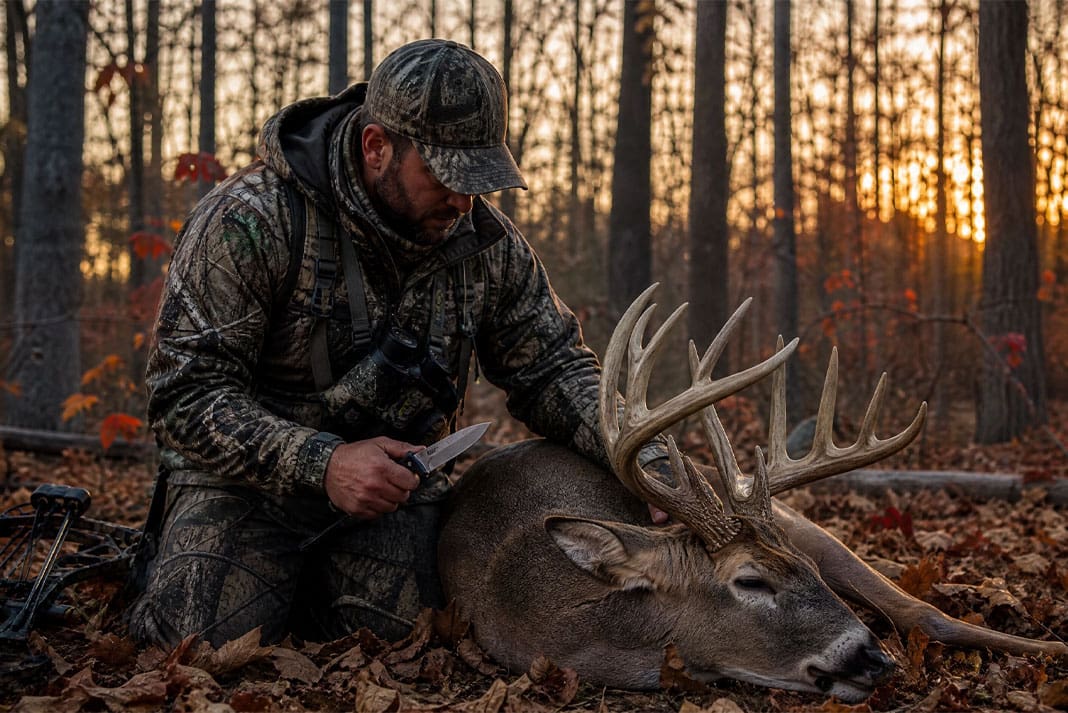

Every hunter knows the feeling. You’re standing over a fresh kill, and your knife lets you down.
The blade slips. The grip is wrong. The edge is already dull after two cuts. That’s not just frustrating. It costs you time, meat quality, and sometimes safety.
Choosing the right hunting knife isn’t complicated, but it does require knowing what actually matters in the field: steel quality, blade geometry, handle ergonomics, and how the knife fits your specific tasks. Here’s a straight-up breakdown of 7 knives worth your money this season.
What Makes a Hunting Knife Actually Good in the Field?
Three things decide whether a knife earns its place in your pack: steel, geometry, and grip. Steel determines how long the edge holds and how easy it is to resharpen. Blade geometry determines how the knife performs on specific tasks like skinning versus field dressing. Grip determines whether you stay in control when your hands are wet and cold.
A knife that excels at one task often compromises on another. A thin, flexible skinner blade is terrible for heavy chopping. A thick, robust camp knife is clumsy for detail work around joints. Know your primary task before you buy.
#1 Noblie Custom Knives: Is a Custom Blade Worth the Investment?
Before diving into our top picks, it’s worth establishing what separates a truly field-ready blade from a generic one. Serious hunters increasingly look for M390 or Damascus steel, ergonomic Micarta or Carbon Fiber handles, and precision locking mechanisms that hold under pressure — the same standards upheld by artisan made knives by Noblie, where bespoke craftsmanship meets functional EDC design. Understanding these benchmarks will help you evaluate every knife on this list with a sharper eye.
Yes, if you want a knife built around your exact needs rather than a mass-market average. Noblie Custom Knives produces handcrafted hunting knives with Damascus and high-carbon steel blades, full-tang construction, and handles made from premium natural materials including stabilized wood, bone, and mammoth ivory.
What separates Noblie from production knives is the level of fit and finish. Each blade is ground by hand, which means the geometry is dialed in precisely. Damascus steel from Noblie typically uses 300+ layer construction, which gives the blade both visual character and genuine performance. The hardness runs 58-62 HRC depending on the steel combination, which is the sweet spot for field use: hard enough to hold an edge through a full elk field dressing, tough enough to resharpen without a bench grinder.
The real-world difference shows up fast. A hunter who switches from a $60 production knife to a Noblie custom typically reports cutting through a deer hide in 40-50% fewer strokes, simply because the grind geometry is optimized rather than compromised for manufacturing cost.
The trade-off is price. Noblie custom knives start around $300 and go well above $1,000 for elaborate Damascus pieces. You’re paying for craftsmanship, not just steel. For a serious hunter who uses their knife every season, that cost amortizes quickly. For a once-a-year weekend hunter, a production knife may be the smarter call.
Expert Tip from Marcus Webb, Professional Big Game Guide: “Don’t obsess over steel grade alone. A perfectly ground blade in 1095 carbon steel will outperform a poorly ground blade in premium S35VN every single time. Geometry is everything.”
#2 Buck Knives 119 Special
The Buck 119 has been in production since 1947. That’s not nostalgia. That’s a 75-year field test. The 6-inch 420HC steel blade holds a working edge well and resharpens easily with a basic ceramic rod. The phenolic handle is slippery when wet, which is the main complaint, but the finger guard compensates. Retail around $60-70.
#3 Benchmade Meatcrafter
Benchmade built the Meatcrafter specifically for processing game, not as a general-purpose camp knife. The 6.08-inch CPM-154 blade has a semi-flexible spine and a swedge grind that reduces drag when slicing through muscle tissue. The handle is textured G10, which stays grippy even with blood on your hands.
CPM-154 runs at 60-62 HRC and holds an edge significantly longer than 420HC. The trade-off: it requires a diamond stone or ceramic rod to resharpen properly. A basic whetstone won’t cut it. Retail around $180.
#4 ESEE 6
The ESEE 6 is built for hunters who also need a survival tool. The 1095 carbon steel blade is 6.5 inches, thick at 3/16 inch, and nearly indestructible. It will baton through wood, pry, and take abuse that would snap thinner blades.
The compromise is weight and bulk. At 14.6 oz with sheath, it’s heavier than a dedicated skinner. But if you hunt remote country where your knife might also be your emergency tool, that trade-off makes sense. Retail around $130.
#5 Havalon Piranta Edge
The Piranta uses replaceable surgical blades. That’s the entire concept. When the edge dulls, you swap the blade in 10 seconds. No sharpening in the field.
This works brilliantly for skinning and caping where you need a razor edge throughout. It’s a poor choice for anything requiring blade strength. The thin replaceable blades snap under lateral pressure. Think of it like a scalpel: precise and sharp, but not a pry bar. Retail around $40, replacement blades around $10 for a 12-pack.
#6 Gerber StrongArm
The StrongArm is a fixed-blade utility knife at $85 retail. The 420HC blade is 4.8 inches with a partial serration option. The rubberized handle is one of the best grips in this price range. It’s not a specialist tool, but it handles field dressing, camp tasks, and general use without complaint.
#7 Ka-Bar Becker BK2 Campanion
The BK2 is a heavy-duty fixed blade in 1095 Cro-Van steel with a 5.25-inch blade and 0.25-inch thickness. It’s overbuilt for pure hunting use, but hunters who also do serious camp work appreciate the durability. Retail around $80.
Which Knife Should You Actually Buy?
It depends on one question: what’s your primary task?
- For skinning and caping: Havalon Piranta or Noblie Custom with a drop-point grind
- For full field dressing on large game: Benchmade Meatcrafter or Buck 119
- For remote hunting where survival matters: ESEE 6
- For a knife that does everything at a fair price: Gerber StrongArm
Expert Tip from Dana Hollis, Hunting Outfitter with 20+ years in Montana: “Carry two knives. A dedicated skinner with a thin, flexible blade and a heavier fixed blade for everything else. Trying to do both jobs with one knife means doing both jobs poorly.”
Does Steel Type Really Change Your Hunt?
Carbon steel like 1095 is easier to resharpen in the field with a basic stone. Stainless like 420HC resists rust better in wet conditions. Premium stainless like CPM-154 holds an edge longer but needs better sharpening tools.
Here’s a practical way to think about it: steel choice is like choosing between a truck and a sports car. The truck (carbon steel) is easier to fix on the side of the road. The sports car (premium stainless) performs better when everything is working right, but you need a proper shop to service it.
For most hunters, 420HC or 1095 carbon steel is the practical choice. For hunters who process a lot of game and maintain their gear properly, CPM-154 or Damascus pays off.
The right knife is the one that fits your hand, your tasks, and your budget. Start with your primary use case, match the blade geometry to that task, and don’t underestimate the value of a handle that stays secure when your hands are covered in blood and cold water. That’s what keeps you safe and efficient when it counts.