
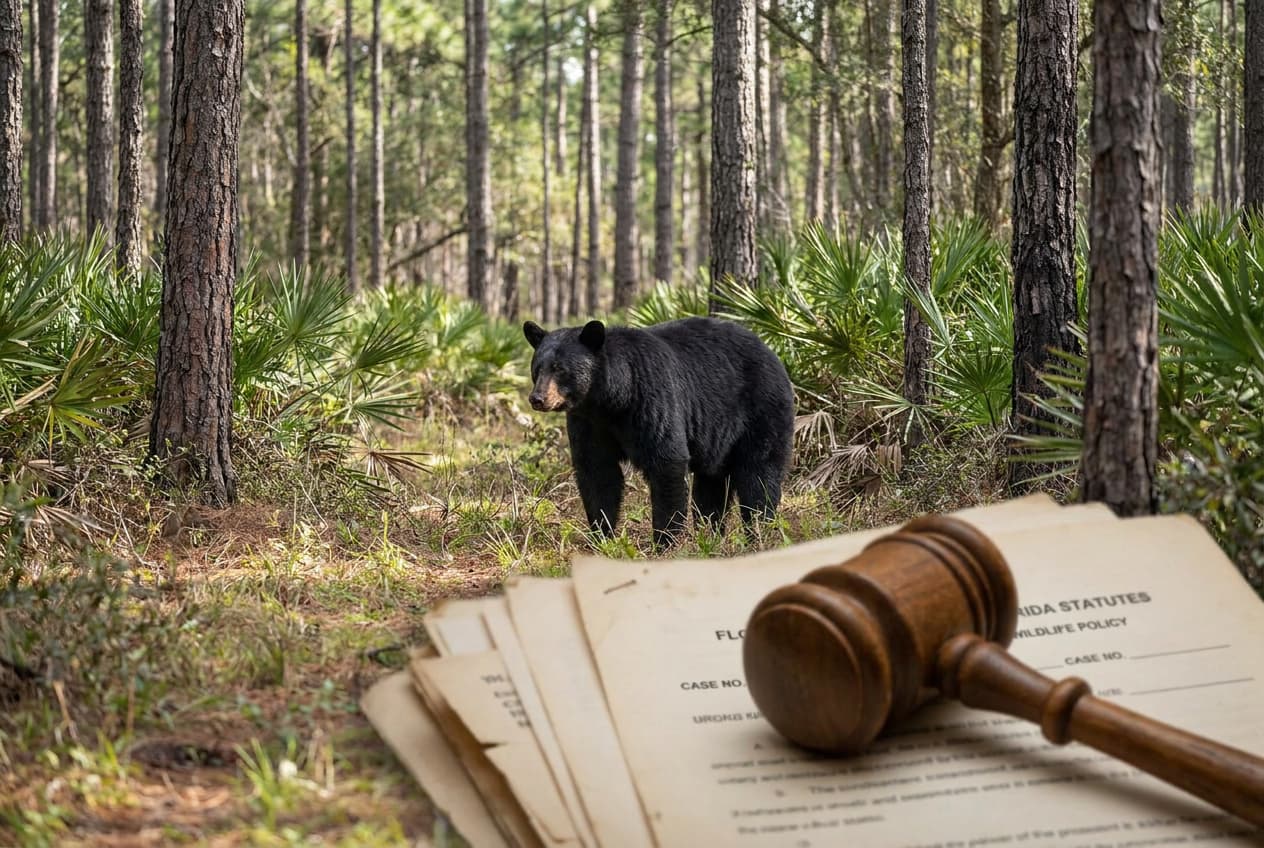

Florida’s 2025 Bear Hunt Survived Its First Legal Challenge — Here’s Everything Hunters Need to Know About What Happened, and What’s Still Ahead
By Hunting Magazine Staff
When a Leon County judge refused to halt Florida’s first black bear hunt in a decade, headlines called it a win for hunters and a loss for the conservation group trying to stop it. That’s true as far as it goes — but it’s only the opening chapter. The hunt happened, results are in, and the underlying legal fight over how Florida manages its bear population is still working its way through court. Here’s the full picture: what the ruling actually said, what happened during the hunt itself, and where the litigation stands now.
The Ruling: Why the Judge Let the Hunt Proceed
In November 2025, Leon County Circuit Judge Angela Dempsey denied a request from Bear Warriors United, a Central Florida-based conservation nonprofit, to block the state’s planned 23-day bear hunt through a temporary injunction. The legal standard mattered here as much as the outcome: to win an injunction, the group needed to show a “substantial likelihood of success on the merits” of its underlying case — a high bar — and Dempsey found they hadn’t cleared it.
Her comparison point was telling. Dempsey noted that Florida’s 2015 bear hunt had already been found constitutional under a “rational basis” legal standard, and that the 2025 hunt was structured to be more conservative than that one — both in the number of bears that could legally be taken and in its December timing, chosen specifically because female bears are typically denned with cubs and less likely to be harvested during that window.
Notably, Dempsey did not dismiss the underlying lawsuit — she only declined to freeze the hunt while the case continued. That distinction is why this story didn’t end with the November ruling.
What Actually Happened During the 2025 Hunt
The hunt ran December 6–28, 2025, across four Bear Management Units — the East Panhandle, North, Central, and South regions — chosen because they hold Florida’s highest bear population densities. The Florida Fish and Wildlife Conservation Commission (FWC) issued 172 permits through a random lottery, each good for one bear, with permits priced at $100 for residents and $300 for non-residents. Any harvested bear had to weigh at least 100 pounds to be legal, a size floor designed to protect cubs and yearlings.
According to FWC’s official bear hunting page, hunters harvested 52 bears over the three-week season — well under the 172-permit ceiling, and a fraction of the 304 bears taken during the far less regulated 2015 hunt, which was cut short after just two days when harvest numbers spiked faster than expected. Every bear taken in 2025 was inspected by FWC biologists or contracted response teams to confirm size and collect population data. FWC Executive Director Roger Young called the season “a success,” noting it made Florida the latest of more than 30 U.S. states that manage black bear populations through regulated hunting.
The Legal Fight Isn’t Over
Here’s what most coverage of the November ruling missed: Bear Warriors United’s underlying lawsuit survived. Dempsey scheduled a follow-up hearing on FWC’s motion to dismiss the case for December 15, 2025 — literally in the middle of the hunt itself — and ultimately allowed the litigation to continue rather than throwing it out.
The core of the group’s argument hasn’t changed: that FWC relied on outdated bear population data, some of it dating to 2014-2015, rather than more current numbers, and treated its own bear management rules as optional guidelines rather than binding requirements. FWC’s attorneys have countered that the agency has broad, constitutionally-derived authority to manage wildlife within the state, and that a Florida court shouldn’t second-guess a wildlife agency’s population-management judgment any more than it would for deer or turkey season.
A trial on the merits was set for August 2026. Safari Club International, which was granted permission to intervene in the case specifically to help defend the hunt, argued in its filings that “almost every North American jurisdiction with a sizable resident black bear population maintains a regulated bear hunting season” and that bear populations in those jurisdictions are stable or growing — a data point worth knowing regardless of where you land on this specific case.
The Numbers Behind the Debate
Understanding why this fight is happening at all requires a little history. Florida’s black bear population collapsed to somewhere between 300 and 500 animals by 1974, when the species was placed on the state’s threatened list. Decades of habitat protection and management brought that number back to an estimated 4,000+ bears today, concentrated mostly in the northern half of the state and the Panhandle — a recovery FWC and conservation groups alike generally agree was a genuine success story. Bears were formally removed from Florida’s threatened species list in 2012.
That recovery is precisely what’s driving the current fight. As bear numbers and human development have both expanded, encounters between the two have risen sharply — the state’s 2019 Florida Black Bear Management Plan explicitly named regulated hunting as one tool for managing population growth in the areas with the densest bear subpopulations, alongside continued habitat protection. Whether the specific population data used to authorize the 2025 season was current enough is exactly what’s now headed to trial.
It’s also worth noting that public opinion on the hunt itself has been sharply divided: an FWC survey of more than 13,000 self-selected respondents found 75% opposed the hunt proposal, with 23% in support — a split that shows up in the passionate arguments on both sides of the Leon County courtroom.
What This Means Going Forward
For hunters, the practical takeaway is straightforward: Florida’s bear hunt happened, was legally upheld against an emergency injunction, and produced a harvest well within its regulated limits. But the legal question of whether FWC followed its own rulemaking process correctly is still unresolved, and the outcome of that trial could shape whether — and how — future bear hunts in Florida get authorized. If you’re planning around a potential future season, that’s the case to watch, not the November 2025 ruling alone.
Frequently Asked Questions
Did Florida’s 2025 black bear hunt actually happen?
Yes. It ran December 6–28, 2025, across four Bear Management Units, and hunters harvested 52 bears out of a possible 172 permits issued.
Is the lawsuit over Florida’s bear hunt still active?
Yes. While the judge declined to block the 2025 hunt, she also declined to dismiss the underlying lawsuit from Bear Warriors United, and a trial on the merits was scheduled for August 2026.
How many bears live in Florida today?
FWC estimates the statewide population at roughly 4,000–4,050 bears, up from as few as 300–500 in the 1970s.
How do you get a Florida bear hunting permit?
Permits are issued through a random lottery drawing for a limited number of designated Bear Management Units. Current pricing and eligibility rules are published on FWC’s official bear hunting page.
What’s the minimum legal size for a harvested bear in Florida?
Under the 2025 rules, harvested bears had to weigh at least 100 pounds, a threshold intended to exclude cubs and small yearlings from legal harvest.
Where can I read Florida’s official bear management policy?
The complete framework is published in FWC’s 2019 Florida Black Bear Management Plan, which first identified regulated hunting as a population-management option.
Hunting Magazine will continue tracking the Bear Warriors United v. FWC litigation as it moves toward trial. For readers who want to follow the case directly or weigh in on future bear management proposals, FWC accepts public comment at BearComments@MyFWC.com.