
Last updated: October 28, 2026
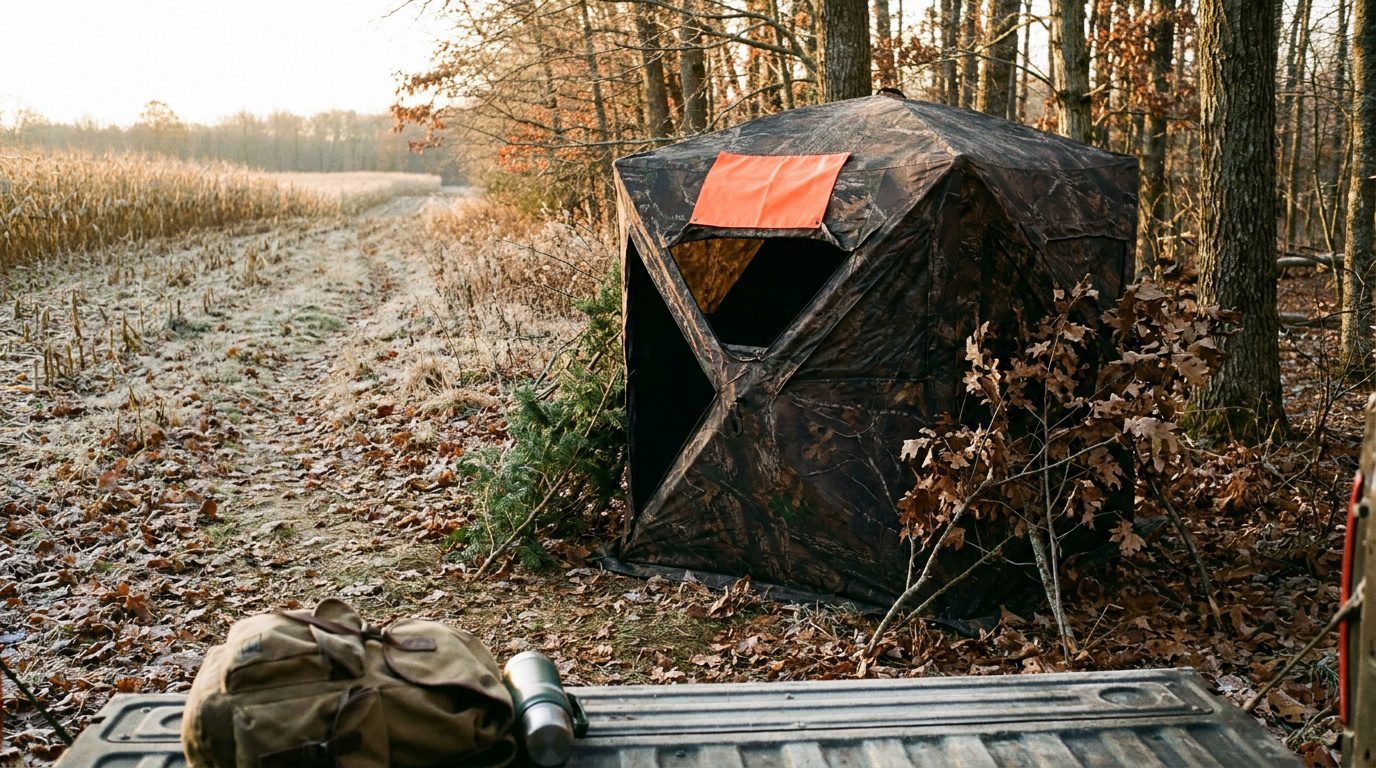
Pick the blind type first. A portable hub or spring-steel ground blind fits hunters who move with the deer. A box or tower blind fits one spot you hunt every year. After that, compare interior height against your bow, footprint, packed weight, anchoring hardware and warranty. Before gun season, find out whether your state requires blaze orange on the blind itself.
Key takeaways
- Choose the blind type first, then compare specs within that type.
- Bowhunters need enough interior height to draw from a chair.
- Pennsylvania and Wisconsin require orange on some blinds. Ohio’s rule covers clothing.
- Any setup that gets you off the ground calls for a full-body fall arrest harness, every time.
This guide is based on manufacturer specifications, published product details and owner reviews. We have not handled these products.
As an Amazon Associate, Hunting Magazine earns from qualifying purchases.
What types of deer blinds are there?
Most deer blinds fall into four groups. Every type gives up one thing to get another. Which one suits you comes down to three things: how often you move, how long you sit and what the weather does where you hunt.
| Blind type | Suits | Strengths | Trade-offs |
|---|---|---|---|
| Pop-up ground blind (hub or spring steel) | Public land, hunters who move setups | Light, packs flat, quick to set up | Fabric moves in wind and wears in sun; needs full staking |
| Box blind (hard-sided) | One proven spot, long cold sits | Weather protection, quiet, room for two | Heavy, hard to move, larger investment |
| Tower or stand-mounted blind | Field edges, food plots, long views | Height for visibility and shot angles | Fall risk, needs a level base and a harness |
| Natural brush blind | Quick, low-cost setups where legal | Matches local cover | Little weather protection; land rules may limit cutting or building |
Which specs matter most on a deer blind?
Ads lead with the camo pattern. These numbers tell you whether a blind will actually work with your weapon and your setup.
- Interior height. If you shoot a vertical bow, compare the listed height with your seated height plus your bow’s length. The top limb has to clear the roof at full draw. Keep in mind that sloped walls bring the ceiling down as you move away from center.
- Window height and layout. Windows that sit too high or too low force you into awkward shooting positions. Look for windows that open partway and quietly.
- Interior finish. A dark interior helps hide movement behind an open window. Ameristep, for example, describes its ShadowGuard interior as built to eliminate shadows and silhouettes that could catch the eye of your game.
- Shoot-through mesh. Read the manufacturer’s instructions before you count on shooting through mesh, and match your broadhead to it. Our broadhead guide explains the head designs.
- Footprint and capacity. A two-hunter rating assumes two people sitting still. Leave room for a chair, a pack and a bow hanger.
- Packed weight. On a long walk in, this number matters more than anything else on the sheet.
- Anchoring hardware. Count the stakes, tie-downs and stake loops. Wind is what usually takes down a fabric blind.
- Warranty and return policy. Find out what’s covered (hubs, poles, fabric) and for how long.
How do published blind specs compare?
Here’s what the manufacturer says. Here’s what the specs and owners show. The table below shows how much four two-hunter ground blinds vary, using figures from manufacturer pages and product listings. It is not a ranking.
| Model | Listed dimensions | Listed weight | Listed details |
|---|---|---|---|
| Ameristep Doghouse (spring steel) | 60 x 60 x 66 in. | 12 lb | 7 window openings, tie-downs and stakes; Amazon listing shows 1-year limited warranty |
| Ameristep Doghouse Run & Gun | 55 x 55 x 61 in. | 8.6 lb | Zippered windows, 55 in. shooting width |
| Ameristep Care Taker (hub) | 59 x 59 x 66 in. (Kick Out version) | Varies by version | Two hunters, interior coating, hub setup |
| Primos Double Bull Roughneck (hub) | 58 x 58 x 65 in.; 69 x 69 hub to hub | 18 lb with bag | Aluminum hubs, silent-slide windows with shoot-through mesh, limited lifetime warranty |
Sources for the table: Ameristep lists the Doghouse at 60″ x 60″ x 66″ and 12 pounds, and the Run & Gun at 55 x 55 x 61 inches and 8.6 pounds. The Doghouse’s Amazon listing shows a 1 year Limited warranty. The Care Taker’s Amazon listing says it comfortably accommodates two hunters. The Kick Out variant is listed as a 59x59x66in Hub-Style Blind. The Primos Roughneck description gives Dims: 58″ x 58″ x 65″ | Hub to Hub 69″x69″, and a retailer’s copy of that description adds the industry-leading Limited Lifetime Warranty and 18 lbs with Bag.
Two cautions. First, published numbers don’t always agree. Cabela’s lists the Roughneck at 66″H x 53″W x 53″D. Second, the Roughneck’s Amazon page says it is currently unavailable. Ask the seller which measurement is right, and check that the blind is actually in stock and what the return window is before you order.
The Run & Gun saves about 3.4 pounds over the Doghouse, and it gives up 5 inches of height to do it. If you walk in a mile with a bow, you feel that trade in both directions.
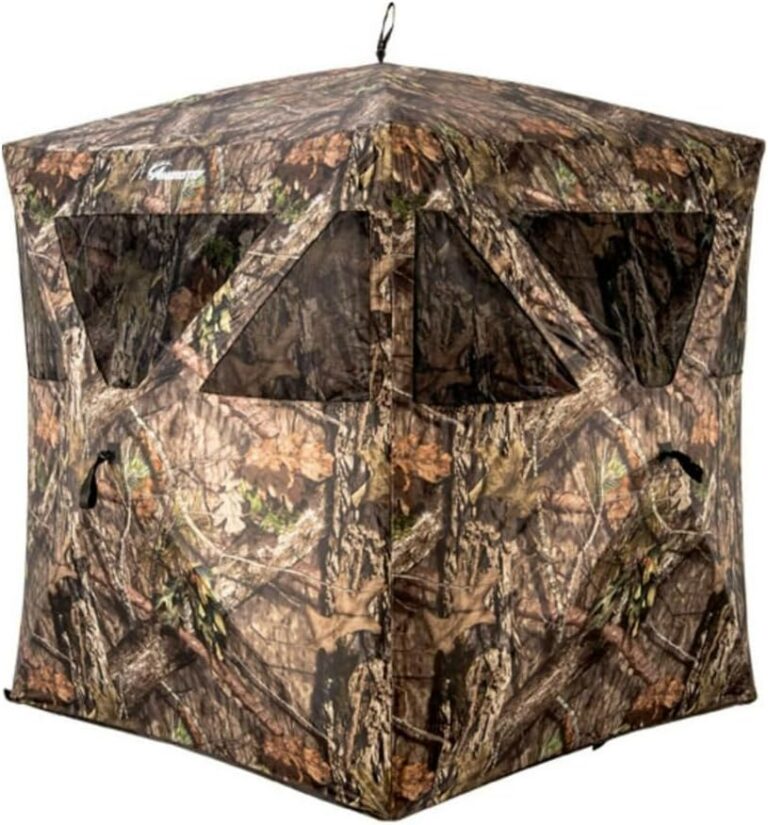
Ameristep Care Taker Ground Blind
- The Care Taker comfortably accommodates two hunters, but its small size makes it easy to transport and deploy in a variety of environments such as heavily…
- Integrated wheels for easy transport
- Mossy Oak Break-Up Country camo covers the entire blind and shoot-through mesh windows.
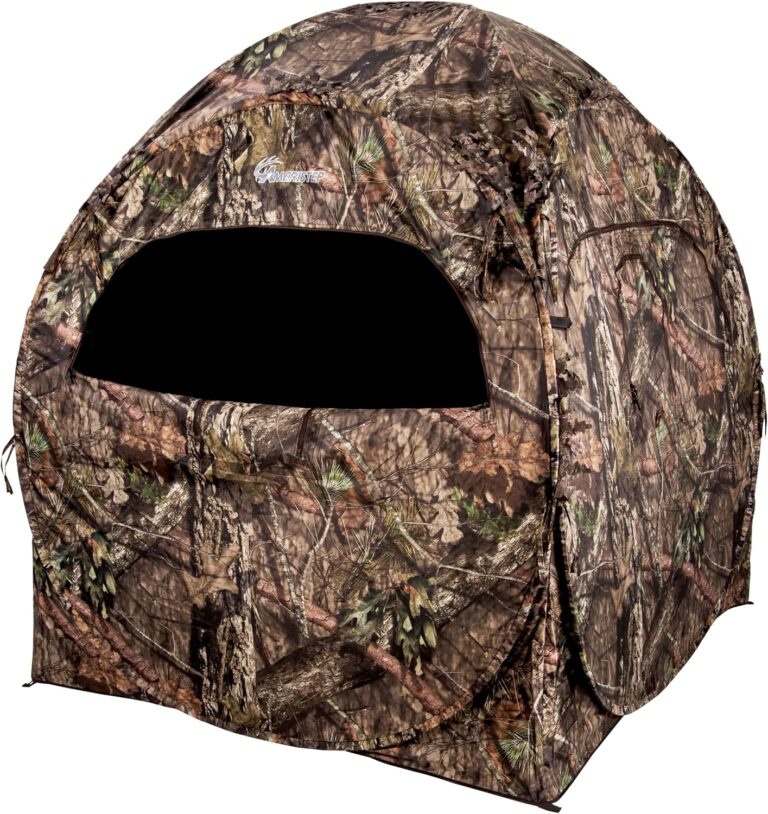
Ameristep Doghouse Run & Gun Hunting Blind
- Getting sent to the doghouse is no longer punishment; it’s the greatest reward; the Doghouse spring steel blind travels easily and sets up quickly to conceal…
- The matte finish of lightweight yet durable Durashell Plus outer fabric and 3D Edge ReLeaf trim that breaks up hard edges for a fully brushed-in look blend well…
- This hunting ground blind from Ameristep features the carbon-enhanced black ShadowGuard interior coating which helps eliminate shadows and silhouettes while…
Ground blind or tree stand?
A ground blind keeps you on the ground, hides your movement and keeps the weather off you. That makes it a good fit for youth hunters, hunters who can’t climb and all-day sits. A tree stand or tower gives you a longer view, and the trade-off is fall risk.
If your setup takes you off the ground, follow the Treestand Manufacturers Association safety guidelines:
- Wear a FBFAHS every time you leave the ground, including while ascending or descending. TMA says single strap belts and chest harnesses are no longer allowed and shall not be used.
- Keep slack out of the tether. TMA says the FBFAHS tether should have no slack when sitting.
- Use a haul line to raise your pack, gear and unloaded gun or bow once you reach hunting height. Never climb with anything in your hands or on your back.
- NEVER exceed the weight limit specified by the manufacturer.
- Carry a way to call for help. The Virginia Department of Wildlife Resources advises hunters to put a whistle, horn, strobe, 2-way radio or a cell phone in your pack. Make sure it is properly charged or have fresh batteries.
Do ground blinds need blaze orange?
That depends on the state, and sometimes on whether the land is public or private. These three states show how much the rules differ. Check your own state’s current regulations before every season.
- Pennsylvania: The Game Commission’s digest states that a minimum of 100 square inches of fluorescent orange material (orange alert band) must be displayed within 15 feet of a blind and visible 360 degrees during the firearms deer, bear and elk seasons. That is on top of the orange you wear inside the blind. The rule has been in 58 Pa. Code § 141.20 since 2010. Confirm it in the 2026-27 digest.
- Wisconsin (DNR-managed lands): The Wisconsin DNR prohibits using a ground blind during any firearm deer season or special hunt unless a minimum of 144 square inches of solid blaze orange or fluorescent pink material is visible from all directions. Waterfowl blinds are exempt. If you leave a blind unoccupied, it has to carry the owner’s DNR customer ID number or name and address. State code also bars placing more than two portable tree stands or blinds on department lands located in the same county.
- Ohio (2026-27): Ohio’s rule applies to what you wear, not to the blind. The 2026-27 Ohio Hunting and Trapping Regulations require anyone hunting any animal except waterfowl, from 30 minutes before sunrise to 30 minutes after sunset during the youth deer gun, deer gun and deer muzzleloader seasons, to visibly wear a solid or camouflage hunter orange vest, coat, jacket or coveralls.
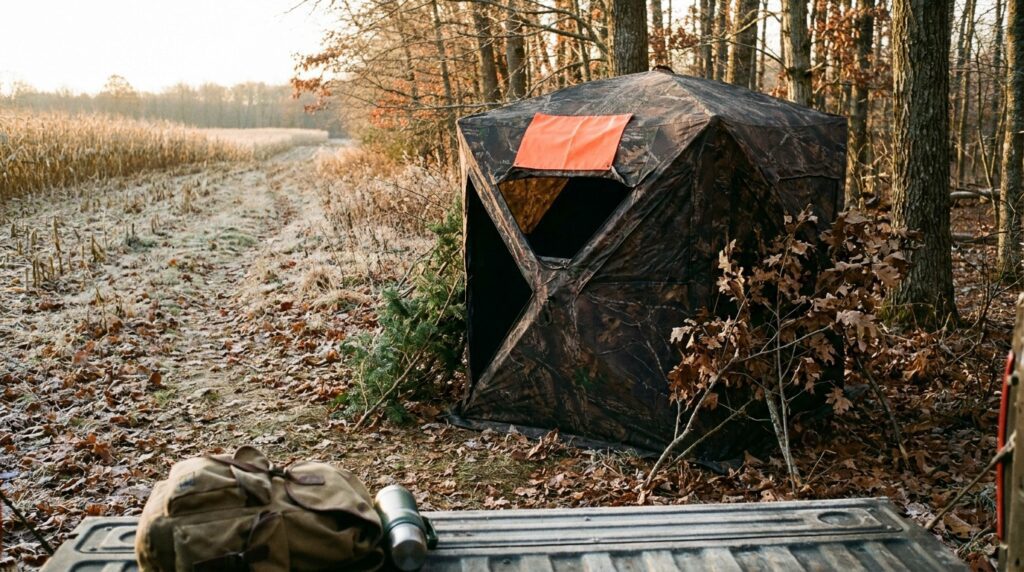
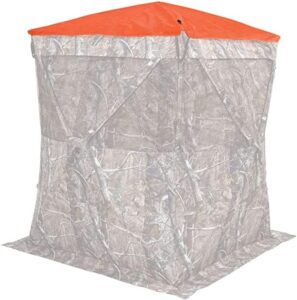
Where your state requires orange on the blind, the simplest fix is an orange cap that goes over the roof. Treat fit as a tolerance question and check it. Ameristep’s listing says its Hub Style cap fits hub-style ground blinds up to a 60-inch footprint, and a separate Spring Steel cap fits its Gunner, Outhouse and Doghouse blinds. Ameristep says its caps meet state requirements. Measure your cap against your state’s square-inch and visibility wording anyway. Even where the law doesn’t require it, a camo blind on a fencerow is hard for other hunters to see during gun season.

How do you set up a deer blind so it works?
- Scout first. Look for trails, rubs and feeding areas. A camera shows you when deer actually use the spot. Our trail camera guide explains what to look for.
- Play the wind. Put the blind where the usual wind carries your scent away from the approach. Have a second spot ready for days when the wind shifts.
- Set it early where rules allow. A blind put out ahead of time gives deer a chance to get used to the new shape. Check public-land rules on leaving blinds in place first.
- Brush it in. Back the blind into cover and break up the outline with local vegetation where cutting is legal.
- Anchor every point. Use every stake, loop and tie-down that came with the blind.
- Range your lanes. Know the distances to landmarks before you hunt. Trim only where it’s allowed.
- Practice from the chair. Shoot from the same seated position and window height you’ll hunt from.
- Keep the inside dark. Wear dark clothing and open only the windows you need.
Baiting rules change by state, county and land type. Read your state agency’s current rules before you put out any attractant. If you plan to call from the blind, see our deer call guide.
How do you maintain a blind between seasons?
- Before each season, check the fabric, seams and window closures for tears.
- Inspect the hubs, poles or spring-steel frame. These are the moving parts and the ones most likely to fail.
- Dry the blind completely before you store it so mildew doesn’t start.
- Keep fabric blinds out of the sun when you aren’t using them.
- On box and tower blinds, check fasteners, the base and the legs every year against the manufacturer’s instructions.
Cal’s Verdict
Specs and warranties tell you more than ads, and this category shows it plainly. Two blinds in the table above list warranty terms of 1-year limited and limited lifetime. One blind has two different sets of dimensions depending on which retailer you read. The camo pattern tells you none of that. Before you look at the photos on any listing, read the height, the weight and the warranty line, and ask the seller if the numbers don’t agree.
Frequently asked questions
What type of deer blind is easiest for a new hunter?
A full-height pop-up ground blind is the easiest place for most new hunters to start. It’s portable, it sets up quickly and it keeps you on the ground, so there’s no fall risk from climbing.
Can I bowhunt from a pop-up ground blind?
Yes, if the blind is tall enough for you to draw from a seat and the windows line up with your chair height. Compare the listed interior height with your seated height plus your bow’s length before you buy.
Do I need blaze orange on my ground blind?
It depends on the state. Pennsylvania requires 100 square inches of orange within 15 feet of a blind during its firearms deer, bear and elk seasons, and Wisconsin requires 144 square inches on ground blinds on DNR-managed lands during firearm deer seasons. Check your state’s current rules before you hunt.
Can I leave my blind up all season?
A blind left in place gives deer time to get used to it, but public-land rules may limit or condition this. On Wisconsin DNR-managed lands, for example, an unoccupied blind must carry the owner’s customer ID number or name and address.
Sources
- Pennsylvania Game Commission (digest reprint): Fluorescent Orange Requirements
- Pennsylvania Bulletin: Protective Material Required, 58 Pa. Code § 141.20
- Wisconsin DNR: Hunting Regulations, DNR-Managed Lands
- Wisconsin Legislature: Administrative Code NR 45.09
- Ohio DNR Division of Wildlife: Ohio Hunting and Trapping Regulations 2026-27
- Treestand Manufacturers Association: Treestand Safety Guidelines
- Virginia Department of Wildlife Resources: Treestand Safety
- Ameristep: Doghouse Ground Blind
- Ameristep: Doghouse Fire Retardant
- Ameristep: Doghouse Run & Gun
- Ameristep: Spring Steel Blaze Cap