
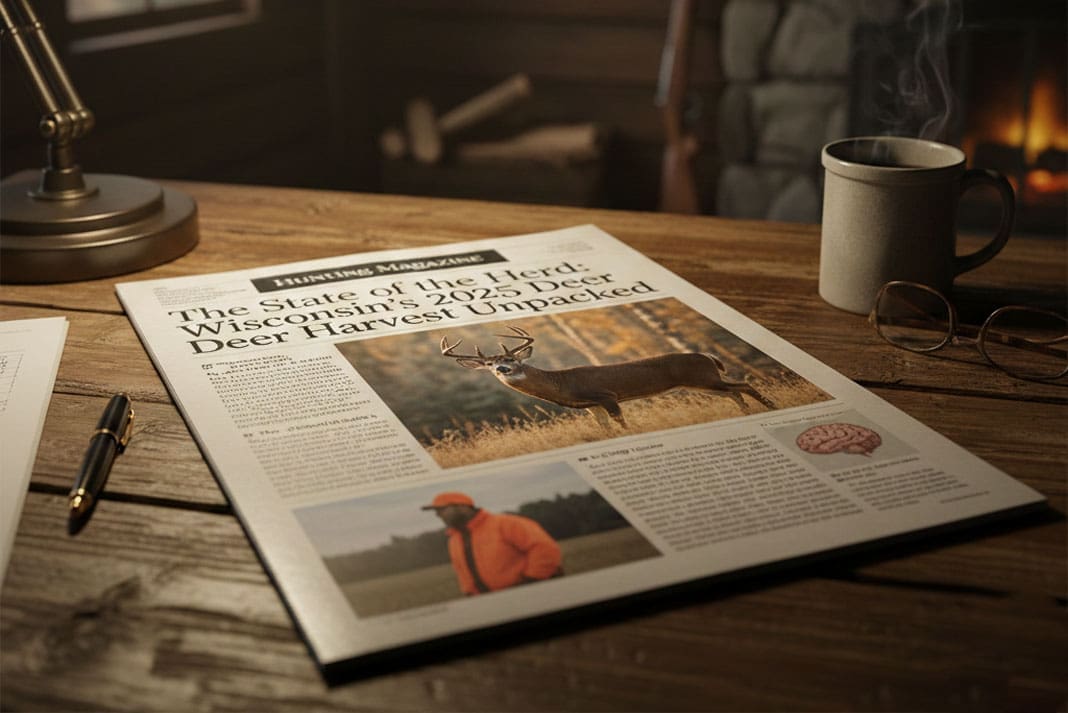

As the orange-clad legions return from the 2025 nine-day gun season, the dust has finally settled on the Wisconsin Department of Natural Resources (DNR) preliminary harvest data. While the tradition remains a cornerstone of the Badger State’s identity, an investigative look at this year’s numbers reveals a herd—and a hunting culture—at a critical crossroads.
2025 Harvest by the Numbers: A Tale of Two Tiers
According to the Wisconsin DNR, hunters registered 182,084 deer during the 2025 nine-day gun season. When we pull back the curtain on these figures, a clear shift in harvest dynamics emerges.
The Antlerless Surge vs. The Buck Decline
For the first time in several seasons, we saw a distinct divergence between buck and doe harvest rates.
-
Antlerless Harvest: 96,016 (Up 0.9% from 2024)
-
Antlered (Buck) Harvest: 86,068 (Down 2.6% from 2024)
-
Total Harvest: Down 0.8% overall from the previous year.
Despite the slight dip in total numbers, the rise in antlerless harvest suggests that hunters are increasingly responding to DNR calls for herd management in farmland zones. Marquette County remains the state’s “Deer Capital,” leading with 7.9 deer registered per square mile.
What the 2025 Data Tells Us About Herd Health
The numbers are more than just a tally for the freezer; they are a vital sign for the health of Wisconsin’s wildlife.
The CWD Factor
The 2025 season brought sobering news regarding Chronic Wasting Disease (CWD). Preliminary testing of over 10,200 samples has already yielded more than 1,000 positive cases. Investigative data from the DNR indicates that in southern counties, where CWD prevalence exceeds 29%, the population is no longer just “infected”—it is actively declining.
Winter Resilience
On a brighter note, the Northern Forest Zone showed signs of recovery. Following two consecutive mild winters, harvest numbers in northwestern counties like Burnett and Washburn trended upward. This suggests that while disease is a threat in the south, weather remains the primary architect of the herd in the north.
The Future of Wisconsin Hunting: 2026 and Beyond
As we look toward the 2026 season and the next decade, three major trends will define the Wisconsin hunting experience:
-
New Management Units: 2025 marked the first year of the new habitat-based Deer Management Units (DMUs). This move away from strict county-line boundaries allows the DNR to manage the herd based on actual landscape capacity rather than political maps.
-
The Demographic Shift: License sales for 2025 were 790,044, a minor 0.12% drop. While the decline has stabilized, the long-term trend of an aging hunter base remains a challenge for recruitment.
-
Access Over Abundance: The investigative consensus is that Wisconsin has no shortage of deer, but it does have a “distribution problem.” Large portions of the herd are locked away on private lands in the south, while public land hunters in some northern areas report seeing fewer deer due to predation and forest maturation.
Looking Ahead
Hunters should expect more aggressive antlerless-only seasons in the Farmland Zones to combat CWD, while the Northern Forest may see continued stabilization if the winters stay kind. The “Golden Age” of 600,000-deer harvests may be in the rearview mirror, but the 2025 data proves that Wisconsin remains a premier destination for those willing to adapt to a changing landscape.
Would you like me to generate a summary of the 2025 harvest numbers specifically for your local county or Deer Management Unit?
This video below provides an expert breakdown from DNR specialists regarding the preliminary harvest data and the factors that influenced hunter success during the 2025 season.